
INVESTIGATION | SACD EXPOSES THE “COMMERCIALISATION OF RELIGION” CONTRADICTION
NEARLY A DECADE AFTER THE CRL INVESTIGATED “COMMERCIALISATION OF RELIGION,” THE QUESTION REMAINS: WHAT EXACTLY IS IT? — INVESTIGATIVE REPORT
The South African Church Defenders (SACD) is raising a fundamental question following the Gauteng consultations of the CRL Section 22 Ad Hoc Committee:
How can “commercialisation of religion” be invoked as part of the case for reforming and self-regulating the Christian sector when, at the Gauteng consultations, the Committee could not provide Pastor Maswinyaneng with a clear, settled definition of what the term means?
This is not a minor technical dispute.
Our investigation shows that the problem goes back to the CRL Rights Commission’s original 2017 Report on the Commercialisation of Religion and Abuse of People’s Belief Systems — and legal scholarship subsequently identified the same definitional weakness.
THE QUESTION THAT EXPOSED THE PROBLEM
During the Gauteng Section 22 Committee consultations, SACD National Coordinator Pastor Maswinyaneng directly challenged the Committee:
“What is commercialisation of religion?”
According to SACD’s record of the consultation, Section 22 Committee Chairperson Dr John Maloma referred to money laundering while responding to the question.
But the matter did not end there.
A further response from within the Committee indicated that there was not yet a settled definition of “commercialisation of religion.”
That produced an obvious contradiction that SACD believes requires a public answer:
If you cannot yet define “commercialisation of religion,” how can the concept already be used in the case being advanced for a self-regulatory framework?
SACD’s account of this Gauteng exchange should be tested against the complete official recording or transcript if the Committee publishes one. But what we can independently establish is even more significant: the absence of a clear definition has been identified before.
THIS PROBLEM DID NOT START IN GAUTENG
The CRL Rights Commission’s investigation into the “Commercialisation of Religion and Abuse of People’s Belief Systems” dates back years.
The CRL’s own 2016/17 annual report describes the investigation as examining leadership practices, funding, expenditure, financial management, registration, monitoring and regulation. Again, that description does not equate “commercialisation of religion” with money laundering
But here is the problem:
Those are examples. They are not, by themselves, a comprehensive definition of “commercialisation of religion.”
LEGAL SCHOLARS HAD ALREADY RAISED THE ALARM
This is where SACD’s investigation becomes particularly significant.
A published legal assessment of the CRL report reached essentially the same definitional problem that resurfaced at the Gauteng consultations.
The scholars stated that the CRL’s finding lacked specificity and that the Commission needed to explain what commercialisation actually meant for purposes of its investigation. Their conclusion was explicit: “the report does not offer a definition” of commercialisation of religion. (ScienceDirect)
The researchers explained why this matters.
Without a definition, religious practitioners cannot know with reasonable certainty which practices are regarded as commercialisation and which are not. They specifically connected this concern to the constitutional rule-of-law principle against vague legal standards. (ScienceDirect)
This criticism was not written by SACD in September 2026.
It was already in the academic record years before the Gauteng confrontation.
A later scholarly book on commercialisation of religion similarly notes criticism that the CRL’s original investigation proceeded without a sufficiently substantive understanding of what “commercialisation of religion” meant. (Springer)
AND NOW WE ARRIVE AT SECTION 22
The connection between the old CRL investigation and today’s Section 22 process is documented by the CRL itself.
When the Commission announced its peer-review initiative in April 2025, it expressly referred back to its 2017 report on commercialisation and abuse of belief systems. It said one recommendation arising from that report concerned establishing a peer-review council to address abuses by some religious leaders.
The present Section 22 Committee says its mandate includes identifying and addressing challenges in the Christian sector and implementing recommendations concerning self-regulation. Its current website says the framework seeks accountability, transparency, protection from exploitation and common ethical standards. 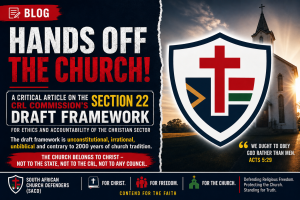
That leaves SACD asking:
Has the process moved from a 2017 investigation into “commercialisation,” through recommendations, peer review and now a proposed self-regulatory framework — without first resolving exactly what “commercialisation of religion” means?
MONEY LAUNDERING IS NOT A DEFINITION OF COMMERCIALISATION
SACD also challenges the reported reference to money laundering during the Gauteng exchange.
Money laundering and commercial activity are not synonymous concepts.
If the concern is money laundering, South Africa already has legislation dealing with proceeds of unlawful activities and money-laundering offences.
But if the concern is something broader called “commercialisation of religion,” then the Church is entitled to know exactly what conduct falls within that category.
Because the consequences of an unclear definition are enormous.
Does selling Christian books constitute commercialisation?
Does selling anointing oil?
Church uniforms?
Coffee?
Conference tickets?
Music?
Ministerial training?
Television subscriptions?
Fundraising?
Charging for accommodation at a Christian conference?
Paying pastors salaries?
Honorariums for visiting ministers?
Operating bookshops?
Owning commercial property to finance ministry?
None of these questions establishes that a particular activity is abusive or legitimate. That is precisely the point.
Without objective criteria, merely establishing that money changes hands does not tell the Church where legitimate economic activity ends and prohibited exploitation begins.
THE COMMITTEE’S OWN POSITION MUST ALSO BE RECORDED
The Section 22 Committee rejects the allegation that its framework amounts to state regulation.
Its official position is that the proposed framework is voluntary, is being developed “by Christians, for Christians,” and proposes no state-imposed licensing or government oversight. It says the purpose is to establish standards of integrity, governance and pastoral care while protecting religious freedom. (CRL Commission)
The Committee also argues that existing criminal and regulatory laws do not necessarily address all internal ethical and governance problems within churches. (CRL Commission)
SACD acknowledges that this is the Committee’s stated position.
But it does not answer the definitional question.
THE QUESTION IS NOW BIGGER THAN ONE CONSULTATION
This investigation has uncovered a striking continuity.
2017: The CRL publishes an investigation into “Commercialisation of Religion and Abuse of People’s Belief Systems.” (South African Government)
Later academic scrutiny: Researchers identify the absence of a sufficiently clear definition of “commercialisation of religion.” (ScienceDirect)
2025–2026: The Section 22 process emerges from the history of those recommendations and develops a Christian-sector self-regulatory framework. (CRL Commission)
September 2026: SACD asks the Committee in Gauteng to define commercialisation of religion and, according to SACD’s record of the exchange, receives references to money laundering while also being told that a settled definition has not yet been determined.
That is the story.
And it demands answers.
SACD DEMANDS CLARITY
The South African Church Defenders therefore puts these questions publicly to the CRL Rights Commission and the Section 22 Committee:
WHAT IS “COMMERCIALISATION OF RELIGION”?
Not examples.
Not allegations.
Not “money laundering.”
Give the Christian sector a precise definition.
What conduct constitutes commercialisation?
What conduct does not?
What objective test will be used?
What evidence demonstrates the scale of the alleged problem?
How many churches were investigated?
What percentage of South African churches were found to engage in the conduct?
And if a future Code of Conduct will determine what is prohibited, why should churches endorse the framework before knowing precisely what activities could ultimately fall within that prohibition?
SACD is not arguing that fraud, exploitation, money laundering or abuse should be protected under religious freedom.
Criminal conduct must be dealt with under the law.
Our investigation raises a different question:
Do not use an undefined concept to construct standards capable of affecting the freedom, governance and practices of the Church.
Nearly a decade after the CRL launched its investigation into “commercialisation of religion,” South Africa’s churches are entitled to something more substantial than examples and shifting explanations.
DEFINE IT.
PRODUCE THE EVIDENCE.
SHOW THE CHURCH WHERE THE LINE IS.
Until then, the question exposed at the Gauteng consultations remains unanswered:
HOW DO YOU PROPOSE TO REGULATE WHAT YOU CANNOT EVEN DEFINE?
SOUTH AFRICAN CHURCH DEFENDERS
CONTENDING FOR THE FAITH
#HandsOffTheChurch
Leave a Reply