
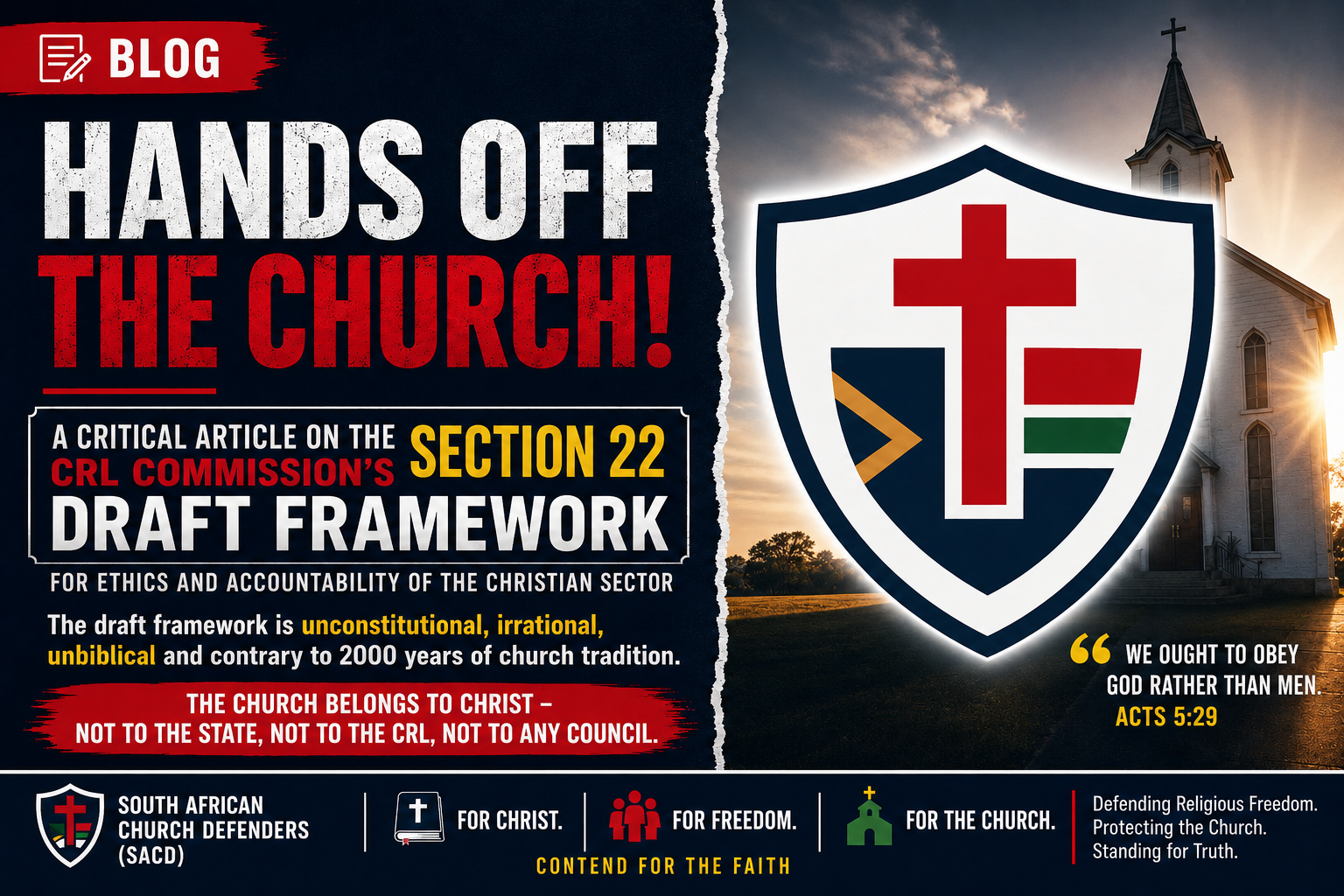
A Critical Article on the CRL Commission’s Section 22 Draft Framework for Ethics and Accountability of the Christian Sector
By the South African Church Defenders (SACD)
The South African Church Defenders has carefully examined the Section 22 Ad Hoc Committee’s Draft Framework for Ethics and Accountability of the Christian Sector. We have considered its language, proposed structures and implications against the Constitution of the Republic of South Africa, Christian faith, church history, established traditions of church governance and lessons from previous attempts to create centralised professional-regulatory structures.
Our conclusion is clear:
The proposed framework should be rejected in its present form.
The CRL Commission describes the framework as voluntary and maintains that it is not intended to constitute state control of religion. However, Christians must look beyond the labels and carefully examine the proposed structures, the source of authority behind them, their relationship with a constitutional institution, and where such a framework could ultimately lead.
South Africa’s Constitution protects freedom of conscience, religion, thought, belief and opinion under Section 15. The question is therefore not whether pastors and churches should be accountable. Of course they should.
The real question is:
Who should determine the standards by which the Church is governed, and who should have the power to enforce those standards?
That is where the serious constitutional and theological questions begin.
- THE CHURCH IS NOT A PROFESSION CREATED BY THE STATE
One of the fundamental problems with the framework is the conceptualisation of Christian ministry as something comparable to a regulated profession.
Human-resource practice provides an important historical lesson.
Professional bodies in South Africa have wrestled for decades with questions of professional designation, statutory authority, registration and accountability. Organisations such as the South African Board of Personnel Practice, the Institute of People Management and other HR structures encountered the difficult reality that professional regulation requires a legitimate statutory foundation, clearly defined authority, appropriate governance and sustainable resources.
The Church is fundamentally different.
Preaching the Gospel is not a profession created by Parliament. It is a calling from God.
Pastors are servants of Christ.
Izinceku zeNkosi.
Bahlanka baModimo.
A pastor does not receive a calling from the state. A church does not receive its spiritual authority from a government commission. The authority of Christian ministry comes from Christ and is exercised within the doctrines, traditions and governance structures of the particular church.
South African churches already operate within a substantial legal environment. Churches and Christian organisations may be registered as non-profit organisations, public benefit organisations or other appropriate legal entities and remain subject to generally applicable laws.
Therefore, the existence of misconduct within some religious communities cannot automatically justify the creation of an overarching regulatory architecture for the entire Christian community.
Bad conduct must be confronted. Abuse must be confronted. Fraud must be confronted. Criminality must be prosecuted. But the existence of wrongdoing does not give the state or a state-established committee authority to define the Church.
- WHO IS THE “CHRISTIAN SECTOR”?
This is perhaps one of the most fundamental questions raised by the framework.
What exactly is the “Christian sector”?
Where does this concept come from biblically?
Where does it come from historic Christian theology?
Where does it come from the structure of the New Testament Church?
The Church of Jesus Christ is extraordinarily diverse. It includes Catholic, Orthodox, Protestant, Anglican, Reformed, Evangelical, Pentecostal, Charismatic, African Independent and many other traditions.
They do not constitute one corporate institution governed by one earthly authority.
The phrase “Christian sector” may be useful as an administrative description for consultation purposes, but it must never become a legal fiction through which an external authority constructs a single regulatory identity for millions of Christians and thousands of churches.
The Church is the Body of Christ.
“And hath put all things under his feet, and gave him to be the head over all things to the church.” — Ephesians 1:22
Christ is the Head of the Church.
Not the CRL.
Not a Practice Council.
Not a government department.
Not a state-appointed religious authority.
- SECTION 2.3: THE PROPOSED LEGISLATIVE FRAMEWORK
Section 2.3 raises profound concerns because it contemplates developing a framework involving legislation, a Christian Practice Council, registration and other mechanisms.
The question is straightforward:
Where does the authority come from to create a body capable of setting standards for the Christian community and potentially determining who complies with those standards?
Legislation is a function of Parliament.
A committee established by the CRL cannot simply assume powers that belong to Parliament.
And if the proposed system ultimately requires legislation, gazetting, statutory recognition or government enforcement, then the issue becomes even more serious.
South Africa’s constitutional democracy does not permit public institutions to acquire powers simply because those powers appear desirable.
Power must have a lawful source.
This is precisely why SACD believes the proposed framework requires rigorous constitutional scrutiny.
- THE CHRISTIAN PRACTICE COUNCIL
The proposal for an Independent Christian Practice Council for Ethics and Accountability is one of the most significant features of the framework.
Even if described as independent and Christian-led, the proposal raises fundamental questions:
Who appoints the council?
Who defines its powers?
Who determines its rules?
Who controls its future authority?
What happens if a church refuses to participate?
SACD rejects the idea that the Church needs a single external or state-facilitated council to determine what constitutes acceptable Christian practice.
The Church can and must regulate itself.
We do not need the state to tell the Church that pastors must be ethical.
We do not need the state to tell Christians that vulnerable people must be protected.
We do not need the state to tell churches that financial integrity matters.
These principles already exist in Scripture, church tradition and ordinary law.
- SELF-REGULATION MEANS SELF-REGULATION
The word “self” matters.
If a church regulates itself, the governing authority must ultimately reside within that church or its legitimately constituted ecclesiastical structures.
If denominations establish their own accountability systems, that is self-regulation.
If independent churches voluntarily form associations and establish ethical standards, that can also be self-regulation.
But when a state institution establishes a committee, facilitates a national framework and seeks to organise an entire religious community under one structure, Christians are entitled to ask whether this remains genuine self-regulation.
SACD’s position is simple:
The Church can and must regulate itself.
- MANDATORY REGISTRATION IS A RED LINE
Any movement towards compulsory registration of churches or Christian leaders should concern every defender of religious liberty.
Even if registration is currently described as voluntary, SACD believes Christians must examine the institutional architecture and the precedent being established.
If voluntary registration becomes the recognised gateway to legitimacy, public confidence, donor recognition or participation within a recognised Christian community, the distinction between voluntary and effectively compulsory participation can become increasingly blurred.
That is why Christians must scrutinise the framework now rather than wait until powers become entrenched.
Religious freedom must be protected before it is restricted, not after.
- ONE CODE FOR ALL CHRISTIANS?
Another serious concern is the proposed common ethical framework.
Of course, Christians should uphold integrity, holiness, honesty, accountability, protection of vulnerable people and responsible leadership.
But Christian communities differ significantly in theology, ecclesiology, worship, church government and pastoral practice.
Catholic, Orthodox, Protestant, Pentecostal, Evangelical, Charismatic and African Independent traditions cannot simply be placed into one institutional mould without carefully considering their legitimate differences.
Paul describes the Church as one body with many members and different functions.
“For as the body is one, and hath many members…” — 1 Corinthians 12:12
Unity does not mean uniformity.
We can defend Christian integrity without creating a central authority that homogenises Christianity.
- ACCOUNTABILITY IS NOT THE PROBLEM
Let SACD be absolutely clear:
We are not opposed to accountability.
We are not opposed to exposing abusive pastors.
We are not opposed to protecting congregants.
We are not opposed to financial transparency.
We are not opposed to criminal prosecution.
We are not opposed to churches disciplining ministers who violate biblical or legal standards.
We are not opposed to ethical leadership.
In fact, the Church should lead the nation in these areas.
Our objection is to the assumption that these legitimate objectives require the creation of an overarching regulatory architecture for Christianity.
Existing South African law already addresses many forms of criminality, abuse, financial misconduct, child protection, labour issues and other unlawful conduct.
Where the law applies, enforce the law.
Where churches have internal governance failures, strengthen church governance.
Where pastors abuse their authority, discipline them and, where appropriate, prosecute them.
But do not use the failures of individuals as justification for placing the entire Church under an externally constructed regulatory system.
- THE QUESTION OF PUNITIVE POWER
The greatest danger in any regulatory system is not necessarily the first rule.
It is what happens when rules become enforceable.
A framework may begin as voluntary.
A council may begin as advisory.
A registration system may begin as optional.
A certificate may begin as a symbol.
But what happens five or ten years later?
What happens when government departments, donors, banks, municipalities, media organisations or the public begin treating the council’s certification as the measure of whether a church is legitimate?
What happens when voluntary compliance becomes a practical requirement?
These are precisely the questions that constitutional democracies must ask before creating new regulatory institutions.
SACD therefore believes that any mechanism capable of imposing sanctions, restricting churches, determining legitimacy or ultimately threatening the continued operation of a church must receive the highest level of constitutional scrutiny.
- PARLIAMENT AND THE POLITICAL QUESTION
SACD also rejects the temptation to blame a particular political party for this entire debate.
This is bigger than party politics.
No Christian movement should reduce this constitutional question to an ANC-versus-opposition issue.
The Constitution belongs to every South African.
Religious freedom belongs to every South African.
The proper question is not:
“Which political party supports this?”
The proper question is:
“Is this compatible with the Constitution and the freedom of religion guaranteed to every person?”
The parliamentary history surrounding earlier CRL proposals demonstrates that this matter has been contested across political lines.
The debate must therefore remain focused on constitutional principle rather than cheap political point-scoring.
- THE CHURCH HAS SURVIVED WITHOUT STATE CONTROL
Christianity did not begin with a government department.
The early Church existed under the Roman Empire.
The Church survived persecution.
The Church survived political empires.
The Church survived dictatorships.
The Church stood against Nazism through voices such as the Confessing Church.
African churches played important roles in resisting apartheid.
Christian communities across Africa and Latin America developed theological traditions that challenged injustice and oppression.
The Church has always had internal mechanisms of discipline, doctrine, accountability and pastoral oversight.
The answer to the failures of some Christians is not to place Christianity under external control.
The answer is to restore biblical leadership, integrity, accountability and holiness within the Church.
- WE MUST NOT ALLOW THE CHURCH TO BE DEFINED FROM OUTSIDE
SACD is particularly concerned about any process that attempts to decide who speaks for Christianity as a whole.
We will defend the religious freedom of people whose theology differs from ours.
We will defend their right to worship.
We will defend their right to organise.
We will defend their right to hold beliefs with which we may profoundly disagree.
But defending someone’s religious freedom does not mean giving every grouping the authority to determine how every other Christian church must operate.
The Church is not a single denomination.
No committee should presume to become the ecclesiastical parliament of Christianity.
- THE TRIPLE CHALLENGES FACING SOUTH AFRICA
South Africa faces enormous challenges:
Unemployment.
Poverty.
Inequality.
Crime.
Corruption.
Economic stagnation.
The Church has an important role to play in confronting these challenges.
We should be feeding the hungry.
Supporting families.
Helping unemployed people.
Rebuilding communities.
Counselling the broken.
Fighting substance abuse.
Supporting victims of crime.
Educating young people.
Preaching the Gospel.
Making disciples.
Serving our communities.
The Church should be part of the solution to South Africa’s problems.
But the Church must remain free to fulfil that mission without being placed under an externally constructed religious regulatory architecture.
- OUR CALL TO CHRISTIAN LEADERS
SACD calls upon pastors, bishops, apostles, prophets, evangelists, theologians, denominational leaders, independent churches and ordinary believers to read the draft framework carefully.
Do not debate it based on social-media headlines.
Read the document.
Study the terminology.
Examine the proposed structures.
Ask where authority comes from.
Ask who appoints the decision-makers.
Ask how the system will be funded.
Ask whether participation can genuinely remain voluntary.
Ask what happens when a church refuses to participate.
Ask what happens to a church that disagrees with the council.
Ask what happens when a voluntary framework becomes a legislative framework.
Ask the hard questions now.
- IF YOU ATTEND A CONSULTATION, MAKE YOUR POSITION CLEAR
SACD encourages Christian leaders who attend consultation meetings to participate responsibly and to place their concerns on record.
Attendance should never automatically be interpreted as endorsement.
If you oppose the framework, say so clearly.
Where appropriate, record your objection in writing and submit a formal written objection or submission.
Do not allow your presence at a consultation meeting to be presented as unconditional support for the framework.
Consultation means consultation — not consent.
- OUR POSITION
The South African Church Defenders therefore calls for the Section 22 Draft Framework to be withdrawn and rejected in its present form.
We believe that:
- Religious freedom must be protected under Section 15 of the Constitution.
- The Church must retain its theological and institutional autonomy.
- Genuine self-regulation must be voluntary and genuinely owned by the religious communities themselves.
- Existing criminal and civil laws must be properly enforced.
- Churches must strengthen their own internal accountability mechanisms.
- No external body should become the gatekeeper of Christian ministry.
- No compulsory registration of churches or pastors should be introduced.
- No central council should be created with authority to determine the legitimacy of Christian churches or ministry.
- Any future legislative proposal affecting religious freedom must receive rigorous parliamentary and constitutional scrutiny.
- The Church must remain free to preach the Gospel, serve society and speak prophetically to government.
CONCLUSION: HANDS OFF THE CHURCH
South Africa is a constitutional democracy.
Christians have constitutional rights.
Churches have legitimate religious autonomy.
Pastors are servants of God.
The Church belongs to Christ.
We therefore say respectfully but firmly:
HANDS OFF THE CHURCH.
We will not oppose accountability.
We will not defend criminality.
We will not protect abuse.
We will not excuse corruption.
But neither will we surrender the freedom of the Church in the name of accountability.
Let the law deal with criminals.
Let churches discipline their leaders.
Let Christians strengthen their own institutions.
Let Parliament exercise the legislative powers entrusted to it by the Constitution.
And let the Church remain the Church.
“We ought to obey God rather than men.” — Acts 5:29
This is not a political battle.
This is not about protecting bad pastors.
This is not about defending abuse.
This is about protecting the constitutional freedom to worship God.
The South African Church Defenders will continue to stand for religious freedom, defend the constitutional rights of Christians and contend for the faith once delivered to the saints.
FOR CHRIST.
FOR FREEDOM.
FOR THE CHURCH.
SOUTH AFRICAN CHURCH DEFENDERS (SACD)
Leave a Reply